
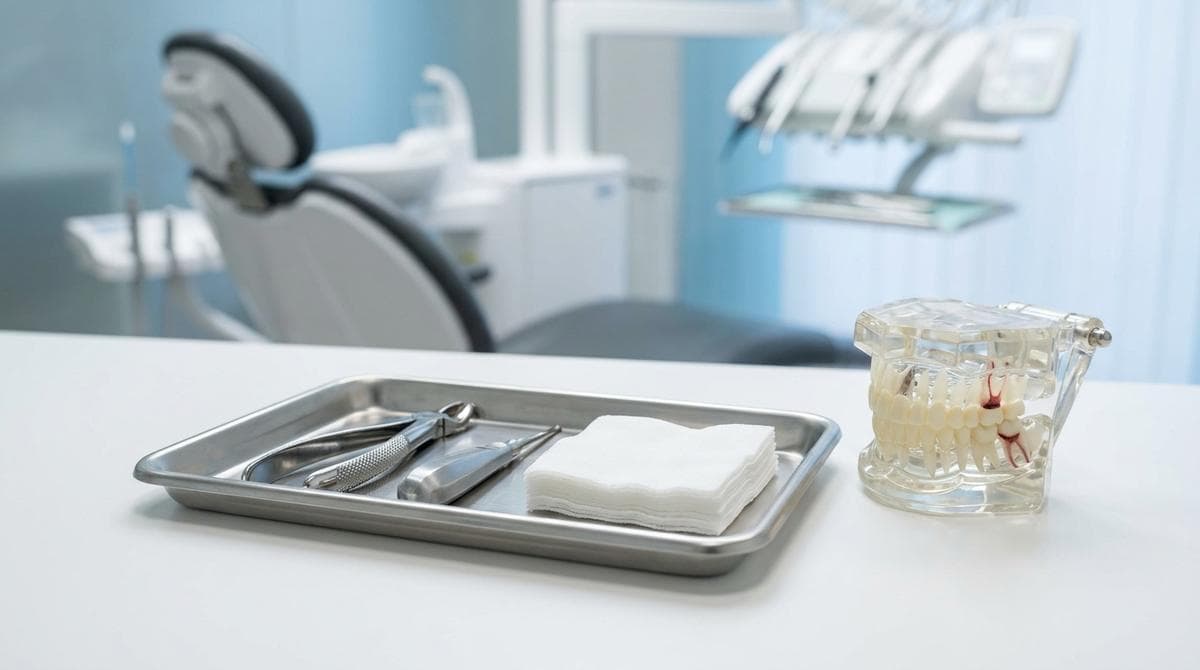
"It's easier to just pull it" is the most common phrase we hear from patients with a painful tooth. Sometimes that really is the best solution. But often a tooth that "can't be saved" can be treated and kept for years — which is always cheaper and simpler than restoring an empty space later. That's why Dentista has a simple rule: first we find out whether the tooth can be saved, and we remove it only when it's really necessary.
In this article: when extraction can't be avoided, how a tooth (including a wisdom tooth) is removed, what to do afterwards hour by hour and day by day, and why you shouldn't leave a gap for long.
When a tooth really needs to be removed
Extraction is indicated when keeping the tooth is impossible or risky:
- the tooth is destroyed below the gum line and can't be restored with a crown;
- there is a cracked or fractured root;
- the tooth is very loose due to bone loss from advanced periodontitis;
- inflammation at the root does not respond to root canal treatment;
- a wisdom tooth grows incorrectly, keeps getting inflamed or damages the neighbouring tooth;
- extraction is part of an orthodontist's plan before braces (decided only after X-rays and calculations).
And here are cases when the tooth can often be saved: deep caries, pulpitis, an abscess, a broken crown with a healthy root. Root canal treatment, a filling or a crown can help. If you were told "it has to come out" but still have doubts, come for a free consultation: the dentist will look at the X-ray and tell you honestly whether there's a chance.
Not sure whether to remove the tooth?
Show it to a Dentista doctor — after an examination and X-ray we'll tell you whether it can be saved and what each option costs. The consultation is free.
Wisdom teeth: remove or keep
The wisdom tooth (third molar) is the most common "candidate" for extraction. But there's no need to remove it "just in case". If it has grown straight, takes part in chewing and is easy to clean, it can stay.
See a dentist if:
- the gum behind the last tooth hurts and swells;
- it has become hard to open your mouth or painful to swallow;
- food gets stuck under the gum "hood", there's an unpleasant smell;
- the neighbouring tooth has developed caries that is hard to clean;
- the front teeth have started to shift.
The decision is made from an X-ray: a panoramic image (OPG) — or a 3D scan in difficult cases — shows how the roots lie and how close they are to the nerve. That determines whether the extraction will be simple or complex.
Why we are against "unnecessary" removal of canines
Canines often grow outside the dental arch, and the first impulse is to remove them. But canines are among the strongest teeth: they take the load when chewing and shape the smile line and a correct bite. Most often a canine sticks out because there isn't enough space in the jaw, and modern orthodontics solves this without extraction — by expanding the jaw, with micro-implants and braces. Removing a canine is a last resort, and it should only be decided together with an orthodontist.
How extraction works at Dentista
- Examination and X-ray. The dentist assesses the tooth, roots and bone and decides whether the tooth can be saved.
- Plan and price first. You know in advance how the extraction will go and what it costs.
- Anaesthesia. The tooth is removed under local anaesthesia. You feel pressure, but not pain. If you are very anxious, tell the dentist — that's completely normal.
- Extraction. A simple tooth takes a few minutes. A complex one (for example, a wisdom tooth lying in the bone) takes longer: the dentist carefully sections the roots to preserve the bone and avoid damaging neighbouring teeth. Stitches are placed if needed.
- Stopping the bleeding and aftercare advice. A sterile gauze pad is placed on the socket, and the dentist explains in detail what you can and can't do over the next days.
- We're available. The clinic is open 24/7 — if anything worries you after the extraction, you can call at any time.
What to do after a tooth extraction: hour by hour and day by day
First 2–3 hours
- keep the gauze pad firmly bitten for 20–30 minutes, then gently spit it out;
- don't eat until the anaesthesia wears off — it's easy to bite a numb cheek or tongue;
- apply cold to the outside of the cheek for 10–15 minutes with breaks.
First 24 hours
- don't rinse vigorously: a blood clot forms in the socket, protecting the wound and helping it heal;
- don't touch the socket with your tongue, fingers or a toothpick;
- don't smoke, drink through a straw or drink alcohol;
- don't warm the cheek, avoid hot baths, sauna and sport;
- eat and drink warm, not hot, and chew on the other side.
Days 2–3
- soft food: porridge, pureed soups, yoghurt, omelette;
- brush your teeth as usual, but very gently around the socket;
- rinses and medication — only those prescribed by the dentist.
Days 7–10 — the gum over the socket usually closes. If there were stitches, the dentist removes them at the follow-up visit.
This is normal: aching pain for 2–3 days, mild swelling (after a wisdom tooth it peaks on day 2–3), pinkish saliva on the first day.
Call right away if:
- bleeding doesn't stop despite pressing a gauze pad for 30 minutes;
- pain gets worse on day 3–4, there's a bad smell and the socket looks empty (this is how socket inflammation — dry socket, alveolitis — shows up);
- your temperature is above 38 °C;
- swelling keeps growing after the third day;
- numbness of the lip or tongue lasts longer than a day.
Something worrying after an extraction?
Dentista is available 24/7 — call +998 90 186 55 05 or +998 95 505 07 70; the dentist will tell you what to do and see you right away if needed.
Why you shouldn't leave a gap for long
One missing tooth may not seem like a big deal, especially if it doesn't show when you smile. But within a few months, changes begin that are hard and expensive to fix later:
- neighbouring teeth tilt towards the gap;
- the opposing tooth over-erupts because it has nothing to bite against;
- bone at the extraction site shrinks — an implant may later require bone grafting;
- the load on the remaining teeth increases and the bite changes.
Restoration options are an implant, a bridge or a denture. The option closest to a natural tooth is a dental implant: it doesn't require grinding down neighbouring teeth and, with proper care, lasts 10–20 years or longer. At Dentista an implant costs approximately 4,500,000 UZS and a crown about 2,500,000 UZS. Sometimes an implant can be placed on the day of extraction — the implantologist decides based on the X-ray. Read more in our article about dental implants.
How much does a tooth extraction cost
The price depends on complexity: a simple extraction of a single-rooted tooth costs less than removing a wisdom tooth that lies in the bone or grows horizontally. Whether an X-ray, stitches or treatment of inflammation are needed also matters. The dentist names the exact price after the examination and X-ray — before the extraction starts. The consultation is free.
If your tooth hurts right now, at night or on a weekend, read what to do with acute toothache and come in: we're open 24/7.
Remove a tooth without pain — or save it
Book a free consultation at Dentista: 34 Zulfiya Khonim St, Shaykhontohur district. Open 24/7, consultations in Uzbek, Russian and English.