
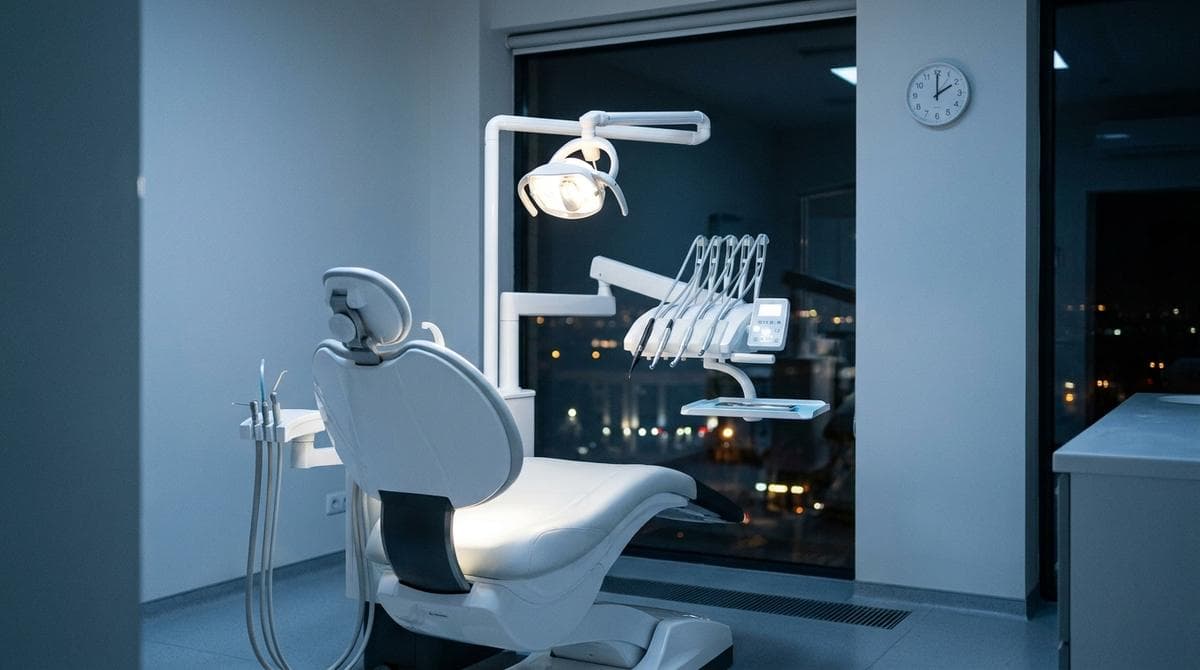
Toothache rarely starts at a convenient time. Most often it comes in the evening or at night: lying down increases blood flow to the head, there is nothing to distract you, and a tooth that only "ached a little" during the day keeps you awake at 2 a.m. The good news: acute pain can almost always be relieved in a single visit. Dentista in Tashkent is open 24/7, including weekends and holidays, so you don't have to wait until morning or Monday.
Below: what to do right now, what you should never do, and when you need to see a dentist immediately.
A tooth hurts right now: what to do in the first 15 minutes
- Rinse your mouth with warm (not hot) water. This removes food debris that may be pressing on the nerve inside a cavity.
- Gently clean the area with dental floss. Sometimes "unbearable pain" is just a piece of meat or a nut stuck between teeth.
- Take a painkiller you have taken before, strictly following the instructions and without exceeding the dose. Swallow it — never put a tablet on the tooth or gum.
- Apply cold to the outside of your cheek — ice wrapped in cloth or a cold bottle for 10–15 minutes, then take a break.
- Sleep with your head raised — throbbing is usually weaker on a high pillow.
- Call the clinic. We'll tell you when to come and see you without a long wait.
Keep in mind that all of this only dulls the pain temporarily. The cause — inflammation inside or around the tooth — does not go away on its own. If the pain stops after a pill, it will come back, usually stronger.
Does a tooth hurt right now?
Dentista is open 24/7. Call us — we'll tell you when to come and relieve the acute pain during the same visit.
What not to do: it only makes things worse
- Warming the cheek with a heating pad, warm compress or salt. Heat speeds up purulent inflammation and swelling.
- Putting a tablet (aspirin, metamizole) on the tooth or gum. It causes a chemical burn of the mucosa — you get an ulcer on top of the toothache.
- Rinsing with vodka or vinegar, "holding alcohol on the tooth". It does not treat anything and burns the tissue.
- Piercing or squeezing a gum abscess yourself. The infection can spread deeper into facial tissues.
- Taking antibiotics "just in case". Without treating the tooth they don't remove the cause and only blur the picture for the dentist.
- Putting up with it for days. Pulpitis that can be treated in 1–2 visits often turns into periodontitis or an abscess within a week — treatment becomes longer and more expensive.
When to see a dentist immediately
Do not postpone the visit even until morning if you have at least one of these signs:
- the cheek, gum or area under the jaw is swelling, and the swelling grows;
- you have a fever or feel weak;
- the pain is throbbing, keeps you awake, radiates to the ear, temple or eye;
- it hurts to bite down, the tooth feels "too tall";
- it is hard to open your mouth (common with inflammation around a wisdom tooth);
- a tooth is broken or knocked out after an injury;
- bleeding does not stop after a tooth extraction.
If breathing or swallowing becomes difficult, or swelling spreads to the neck, call an ambulance at 103 right away.
If a tooth is knocked out: hold it by the crown, not the root, don't scrub it, put it in milk or saline and come as fast as you can — the first 1–2 hours decide whether it can be saved.
Why a tooth hurts: common causes and treatment
- Deep caries. Pain from cold or sweet food that passes in a few seconds. Treatment: cleaning the cavity and a filling, usually in one visit.
- Pulpitis (nerve inflammation). Strong spontaneous pain, especially at night, radiating to the ear or temple. Treatment: root canal treatment; the pain is relieved at the first visit.
- Periodontitis and abscess. Pain when biting, possible swelling and fever. Treatment: the dentist opens the tooth to drain the infection, then treats the canals; if the tooth can't be saved, it is removed.
- Crack or chip. Sharp pain when chewing. Treatment: a restoration or a crown, depending on how deep the crack is.
- Inflammation around a wisdom tooth. The gum behind the last tooth hurts, it's hard to open the mouth. Treatment: calm the inflammation, then decide whether to keep or remove the tooth.
- Sensitivity. Short pain from cold and sour food. Treatment: strengthening the enamel and covering exposed tooth necks.
You can't tell the cause by eye — the same pain can come from caries or a cracked root. That's why the dentist always starts with an examination and an X-ray.
How an emergency visit works at Dentista
- A call. You describe what hurts, we tell you when to come. You can also message us on Telegram.
- Examination and X-ray. The dentist finds the tooth causing the pain — sometimes one tooth hurts but the pain is felt in another.
- Anaesthesia. Treatment is done under local anaesthesia: you feel touch, but not pain.
- We relieve acute pain during the same visit. Depending on the cause, we treat the caries, open the tooth and clean the canals, drain the inflammation, place medication and a temporary filling.
- Plan and price first. The dentist explains what's wrong with the tooth, what the options are and how much each costs. No surprises at the end.
- Finishing the treatment at a time that suits you, without rush.
The consultation is free, and we see patients in Uzbek, Russian and English.
What treatment costs — and why waiting is the most expensive option
Toothache has an unpleasant feature: every next stage costs noticeably more than the previous one. Approximate prices at Dentista:
- caries, filling — about 500,000 UZS;
- nerve inflammation, root canal treatment — about 1,200,000 UZS;
- tooth destroyed, crown needed — about 2,500,000 UZS;
- tooth can't be saved, implant with crown — from 7,000,000 UZS.
The difference between "came on the first night of pain" and "waited a month" easily reaches several million sum. The exact price depends on the tooth — the dentist names it after the examination and before treatment starts.
Why people come to Dentista with acute pain
- 24/7, no days off. The clinic is open at night, on Sundays and holidays.
- Everything in one clinic. General dentists, an implantologist and an orthodontist: if you need a root canal, crown or implant after the pain is gone, you don't have to look for another doctor.
- Pain-free. Modern local anaesthesia, including for patients afraid of dentists.
- Clear pricing. Plan and price before treatment.
- Central Tashkent. 34 Zulfiya Khonim St, Shaykhontohur district.
- Three languages. Uzbek, Russian, English.
If your child has a toothache, we can help too — read how children's dentistry works at Dentista.
Don't wait for the morning
Call +998 90 186 55 05 or +998 95 505 07 70 — the clinic is open 24/7. Or leave a request and we'll call you back.